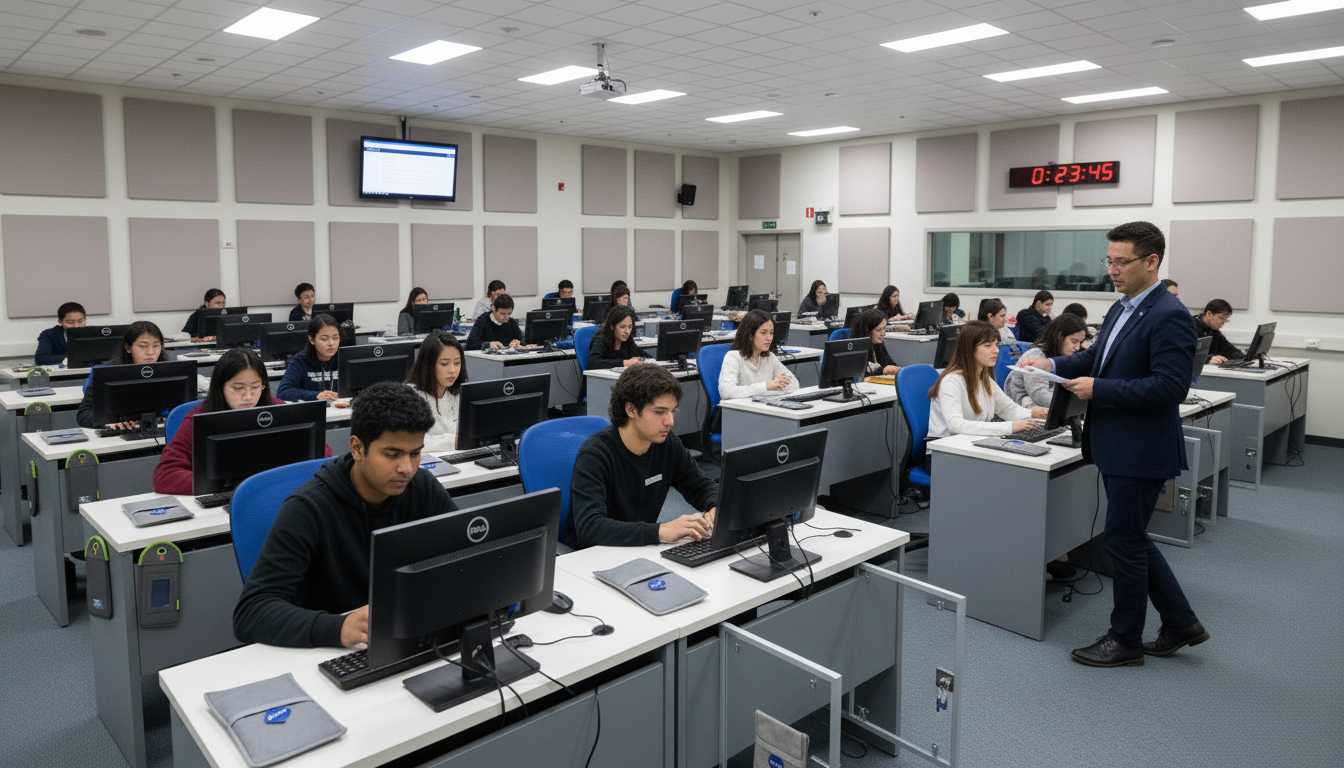
Exam season brings a familiar stress to school administrators: how do you make sure students are not using their phones to cheat, without triggering a fight with parents over confiscation? The problem is getting harder to solve every year. Smartphones are more powerful, messaging apps are instant, and a photo of an exam paper can reach a WhatsApp group in seconds.
Schools that rely on a "leave your phone at the door" policy know it does not work. Students forget, staff cannot enforce it consistently, and one incident is enough to invalidate an entire sitting. Schools that confiscate phones face a different problem: parents who want to know where their child's phone is, liability if something gets damaged or lost, and teachers spending exam time managing a pile of devices instead of invigilating.
Lockable phone pouches solve both problems at once.
Why Traditional Approaches Fail
Most schools try one of three things. They ask students to put phones in bags under the desk. They collect them at the door. Or they simply ban phones from the premises and hope students comply. None of these holds up under pressure.
- Bags under the desk are not a solution. A phone face-down in a bag can still receive and display notifications. A student who is determined to cheat can access it with little movement.
- Collection at entry creates a logistical burden. Each phone needs a label, a storage location, and a return process. Staff time is spent managing objects, not supervising students. And the school is liable if anything goes missing.
- Campus-wide bans only work if every student complies every time, which they do not.
The issue is not student intention. Most students do not plan to cheat. The issue is opportunity: a phone within reach, a moment of weakness, and a difficult question on the paper. Removing the opportunity is far more effective than relying on willpower or policy.
How Lockable Pouches Work in an Exam Setting
The process is simple. At the start of each exam, students place their phone inside a neoprene ZenLocked pouch. The pouch is sealed with an EAS magnetic lock tag, the same technology used in retail clothing stores. The student keeps the pouch with them throughout the exam. There is no storage cupboard, no labelling, no handover.
The phone cannot be accessed during the exam. The EAS tag can only be removed with a magnetic detacher held by authorised staff. At the end of the sitting, students hand in their paper and the teacher unlocks the pouch. The whole process takes under a minute per student at each end.
"The pouch stays with the student, so parents are satisfied. The phone is inaccessible, so we are satisfied. We stopped having the argument entirely."
Secondary school coordinator, Netherlands
Benefits Beyond Cheating Prevention
The primary reason schools adopt ZenLocked pouches for exams is cheating prevention. But administrators consistently report secondary benefits they did not anticipate.
Reduced anxiety
Students who know their phone is locked and with them report lower exam anxiety than students who have handed their device to staff. The pouch removes the worry of "is my phone safe" from the equation, allowing students to focus on the paper in front of them.
Faster invigilation
Invigilators spend less time watching for phone activity and more time on legitimate supervision. Exam halls where phones are locked report fewer disruptions overall, including fewer requests to leave the room.
Parent confidence
Parents who previously objected to campus-wide phone bans are more comfortable with lockable pouches. The phone stays with the child, in a tamper-evident sealed container. No school staff handles it. This removes one of the most common points of friction between schools and families over device policies.
Which Countries Are Moving in This Direction
Phone-free exam policies are accelerating across Europe and Asia. France has maintained a strict phone ban in schools since 2018 and is now extending enforcement mechanisms. The Netherlands introduced a national ban in January 2024, with exam periods specifically highlighted as no-phone zones. Spain has implemented regional legislation in several comunidades, with exam settings cited as the priority use case. Australia mandated phone-free schools at a state level across multiple territories, with exam rooms leading the rollout.
In Asia, Vietnam launched a government-backed phone-free schools pilot in Ho Chi Minh City in October 2025, covering 16 schools. The pilot explicitly targets exam periods as the highest-risk moments for distraction and misconduct. Singapore, which has some of the most rigorous national exam standards in the world, is actively reviewing device policies for high-stakes testing environments.
The direction of travel is clear. Schools that implement a workable phone management solution now will be ahead of legislation rather than reacting to it.
Implementation: What Schools Need to Know
Schools typically start with a class set of 30 to 35 pouches and one or two detachers. This covers a standard exam sitting. Larger schools with multiple simultaneous sittings scale up accordingly, with pouches pooled between exam halls and detachers assigned to each room.
The pouches are reusable, durable neoprene, and carry the school's logo if required. EAS tags cost a fraction of a euro each in bulk. The main investment is the detacher, which is a one-time purchase per exam room. Total cost for a school of 500 students is significantly lower than a single year of managing phone-related incidents or appeals.
ZenLocked works with school administrators to plan the right configuration before any order is placed. There is no minimum order for initial trials, and sample pouches are available on request.
A Practical Step Ahead of Exam Season
If your school has exams running in the next few weeks and phone management is still an open question, a lockable pouch system can be deployed in days. There is no installation, no app, no training beyond a two-minute staff briefing. The pouch goes on, the lock clicks, the exam runs without interruption.
Schools across Europe and Asia are moving away from the confiscation model not because it is wrong in principle, but because lockable pouches achieve the same result with fewer problems. Students keep their phone, staff keep their focus, and the exam runs as it should.
Related Articles
Ready for Phone-Free Exams?
Get a quote for your school. Sample pouches available. No minimum order for first trials.
Request a Sample