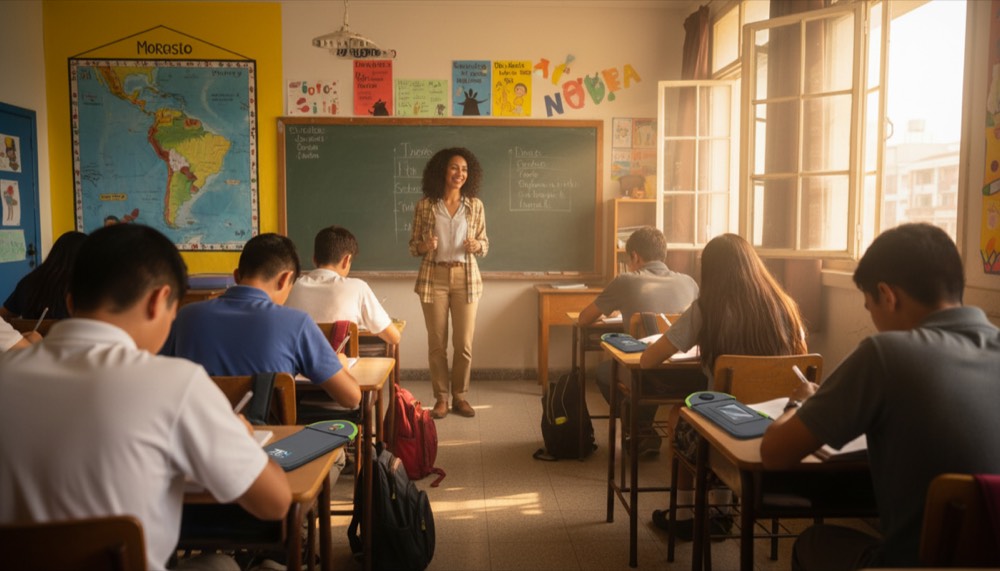
Latin America is joining the global phone-free schools movement. Schools worry about attention, cyberbullying, and grades. So governments are moving from talk to action. Chile went furthest with a national law. Mexico, Brazil, Colombia, Argentina, and Peru are close behind. For school leaders, the question is no longer "should we restrict phones?" It is "how do we do it?"
Where Latin America Stands Now
Europe has been building phone bans since France's 2018 law. Latin America's move is newer and faster. Several countries are jumping straight from no rules to a national law. UNESCO's advice pushes this along. So do the results from schools in Europe and Australia.
The region has one problem. People know the issue and politicians are on board. But almost no phone pouch or tool suppliers work locally. In the United States, Yondr has run the school pouch market for years. In Latin America, that kind of supplier does not exist yet. Schools that want physical tools have to buy them from abroad.
Country-by-Country Breakdown
Chile
National LawChile approved a national ban at the end of 2025. It starts in the 2026 school year. The law bans phones and personal electronic devices for the whole school day, including recess and breaks. It covers all primary (basica) and secondary (media) schools in the country.
The push came from clear evidence. Phones during school hours were hurting attention, raising cyberbullying, and cutting face-to-face time between students. Chilean education officials pointed to UNESCO data and European examples while writing the law.
Schools must set their own rules for enforcing it. The law does not force one method. Each school can pick lockable pouches, phone lockers, or collection systems. Early schools in Santiago and Valparaiso say the rollout goes smoother with physical tools than with a rule alone.
- Scope: All primary and secondary schools nationwide. Full school day including breaks.
- How it's enforced: Schools choose their method. Lockable pouches and storage boxes both in use.
- Key stat: Chile's Congress approved the ban in December 2025, taking effect for the 2026 school year.
Brazil
National LawBrazil passed a national phone ban in schools in January 2025. It is one of the largest countries in the world to do this. The law bans phone use in classrooms, during breaks, and in all school common areas. It covers students in public and private schools.
Over 47 million students are in basic education, so the rollout is huge. Brazilian states are writing their own rules for enforcing it. Many schools are looking for practical tools right now. The law allows exceptions for students with medical needs and for lessons a teacher approves.
- Scope: All public and private schools. Covers classrooms, breaks, and common areas.
- How it's enforced: State guidelines in progress. Schools pick their own method.
- Key stat: Covers about 47 million students, one of the world's largest phone bans.
Mexico
State-Level InitiativesMexico has no national phone ban yet. But the talk is moving fast at the state level. Several states have proposed or are debating laws to limit phone use in schools. The federal education body (SEP) has told schools to limit phone use during class hours.
Private and international schools in Mexico City, Monterrey, and Guadalajara moved first. Many of these schools serve families who follow phone-free trends in the US and Europe. They set their own rules before any law forces them to. Public schools in states with active bills are starting to get ready too.
- Scope: State level. Several states are debating or adding limits. No national law yet.
- How it's enforced: Private and international schools lead. Public schools follow where states act.
- Key stat: Mexico has 36 million students, so any future national policy is a huge rollout.
Colombia
EmergingColombia is at an early stage on phones in schools. There is no national law yet. But the Ministry of Education has flagged the issue, and several bills are moving through Congress. Some schools, mainly private ones in Bogota, Medellin, and Cartagena, set their own phone-free rules.
Colombian teachers point to more classroom distraction and cyberbullying as the main reasons. The country has a large private school sector that often follows international standards. It will likely lead the way before any government rule arrives.
- Scope: School-level policies. No national or regional law yet.
- How it's enforced: Private schools leading the way. Public policy still being discussed.
- Key stat: Bills to limit phones are being debated in Congress.
Argentina
School-LevelArgentina decides phone rules at the province and school level, in line with its federal setup. Buenos Aires Province teaches about 40% of the country's students and has done the most. Several schools there run phone-free zones or full-day rules.
Private schools in Buenos Aires, Cordoba, and Mendoza are testing phone pouches and phone-free periods. The national talk grew after Argentina's teacher unions pointed to how phone distraction hurts teaching and student mental health.
- Scope: Provincial and school-level. No national law.
- How it's enforced: Buenos Aires Province leads. Private schools set their own rules.
- Key stat: Teacher unions are pushing for formal phone limits.
Peru
EmergingPeru is watching Chile closely. The Ministry of Education has noted the growing evidence for phone-free classrooms. There is interest in a law like Chile's. Several private schools in Lima already run phone-free rules, mostly ones with international ties.
- Scope: School-level in private sector. Government monitoring regional trends.
- How it's enforced: Early stage. Private schools in Lima leading.
- Key stat: Chile's success next door is speeding up local talks.
"There is now a substantial evidence base which concludes that smartphone use is linked to reduced educational performance. Banning smartphone use in schools could help curb distraction and create focused learning environments."
The LATAM Market Gap: Few Local Pouch Providers
One big difference here is the lack of phone pouch suppliers. In the United States, Yondr supplies thousands of schools. In Europe, several suppliers compete. In Latin America, schools that want lockable pouches have few local suppliers. So most buy them from abroad.
This gap matters because physical tools work. Schools across Europe and Australia keep reporting the same thing. Lockable pouches bring better follow-through, fewer fights between teachers and students, and a smoother start than a rule alone. With no local supplier, Latin American schools order pouches from abroad. That adds shipping time and some hassle. It does not change how well the tool works.
Why Latin American Schools Are Moving Now
A few things are driving the phone-free move across Latin America:
- Chile's 2025 national law set an example that other countries are studying and copying
- Brazil's 2025 national ban added weight. Even the region's largest country treats this as a priority
- UNESCO's global advice gave education ministries the backing to act
- European and Australian results show real gains in attention, grades, and student wellbeing. LATAM policy talks cite them often
- Parent demand is growing, mostly at private and international schools whose families follow global trends
- Cyberbullying during school hours worries countries where over 80% of minors own a smartphone
What This Means for Your School
If your school is in Latin America and thinking about a phone-free policy, the timing is right. Laws are moving fast. Parent support is strong. Early schools in the region report good results. Here is a simple way to start:
- Check your country's status in this guide. Then confirm with your national or state education authority for the latest updates
- Ask parents and staff to build agreement. In most Latin American schools, over 70% of parents back phone limits
- Pick your method based on school size and budget. Lockable pouches work at any size and take the policing job off teachers
- Run a pilot in one grade before going school-wide. This builds confidence and lets you fix problems
- Frame it as a plus. Sell the change as more room for focus, connection, and learning, not as a punishment
- Order your tools early. No local pouch suppliers exist here yet, so plan for shipping time from abroad in your rollout
Ready to Create Phone-Free Classrooms?
ZenLocked provides lockable phone pouches for schools across Latin America. Simple to implement, no confiscation needed, and students keep their phones on them all day. We ship directly to schools in Chile, Mexico, Colombia, Argentina, Brazil, Peru, and the rest of the region.
REQUEST A CONSULTATION